
KCNG3; Potassium voltage-gated channel subfamily G member 3; Voltage-gated potassium channel subunit Kv10.1; Voltage-gated potassium channel subunit Kv6.3
宿主:
Rabbit
稀释比:
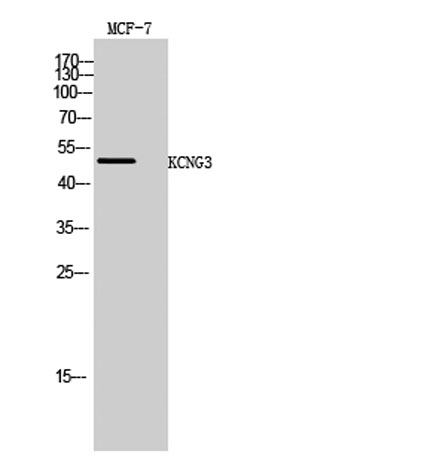
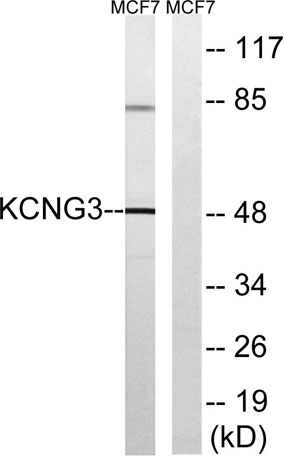
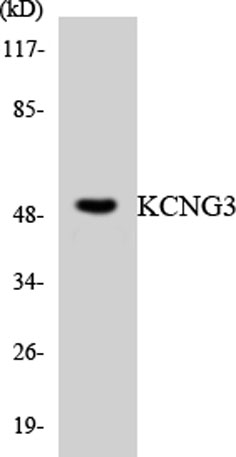
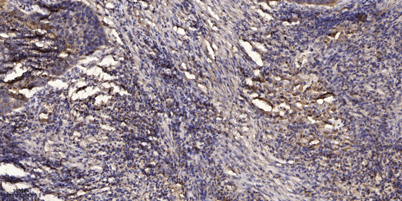
WB 1:500-2000;IHC-p 1:50-300
免疫原:
The antiserum was produced against synthesized peptide derived from human KCNG3. AA range:183-232
储存条件:
-20°C/1 year
克隆性:
Polyclonal
抗体亚型:
IgG
浓度:
1 mg/ml
实测条带:
50kD
基因ID:
170850
蛋白序列:
Q8TAE7
细胞定位:
Cell membrane ; Multi-pass membrane protein . Cytoplasm . Has to be associated with KCNB1 or possibly another partner to get inserted in the plasma membrane (PubMed:12060745). Colocalizes with KCNB1 at the plasma membrane (PubMed:12060745, PubMed:19074135). Remains intracellular in the absence of KCNB1 (PubMed:12060745). .
研究背景:
Voltage-gated potassium (Kv) channels represent the most complex class of voltage-gated ion channels from both functional and structural standpoints. Their diverse functions include regulating neurotransmitter release, heart rate, insulin secretion, neuronal excitability, epithelial electrolyte transport, smooth muscle contraction, and cell volume. This gene encodes a member of the potassium channel, voltage-gated, subfamily G. This member is a gamma subunit functioning as a modulatory molecule. Alternative splicing results in two transcript variants encoding distinct isoforms. [provided by RefSeq, Jul 2008],