
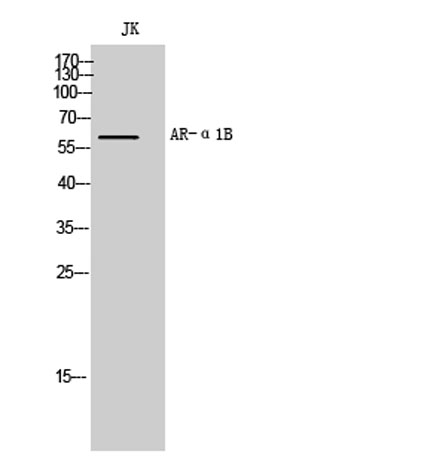
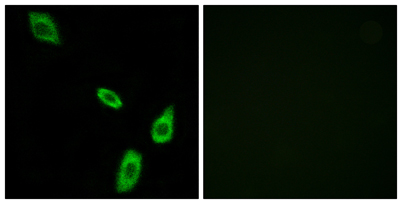
Western Blot: 1/500 - 1/2000. Immunofluorescence: 1/200 - 1/1000. ELISA: 1/20000. Not yet tested in other applications.
Immunogen:
The antiserum was produced against synthesized peptide derived from human ADRA1B. AA range:431-480
Storage:
-20°C/1 year
Clonality:
Polyclonal
Isotype:
IgG
Concentration:
1 mg/ml
Observed Band:
60kD
GeneID:
147
Human Swiss-Prot No:
P35368
Cellular localization:
Nucleus membrane; Multi-pass membrane protein. Cell membrane ; Multi-pass membrane protein . Cytoplasm . Membrane, caveola . Location at the nuclear membrane facilitates heterooligomerization and regulates ERK-mediated signaling in cardiac myocytes. signaling in cardiac myocytes. Colocalizes with GNAQ, PLCB1 as well as LAP2 at the nuclear membrane of cardiac myocytes.
Background:
Alpha-1-adrenergic receptors (alpha-1-ARs) are members of the G protein-coupled receptor superfamily. They activate mitogenic responses and regulate growth and proliferation of many cells. There are 3 alpha-1-AR subtypes: alpha-1A, -1B and -1D, all of which signal through the Gq/11 family of G-proteins and different subtypes show different patterns of activation. This gene encodes alpha-1B-adrenergic receptor, which induces neoplastic transformation when transfected into NIH 3T3 fibroblasts and other cell lines. Thus, this normal cellular gene is identified as a protooncogene. This gene comprises 2 exons and a single large intron of at least 20 kb that interrupts the coding region. [provided by RefSeq, Jul 2008],