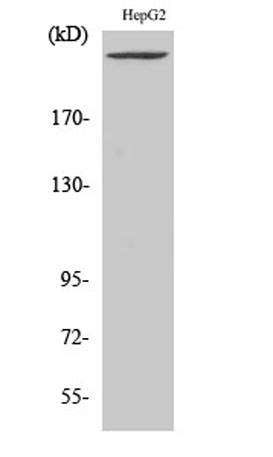
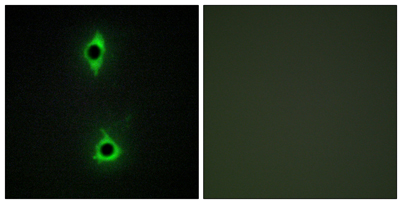
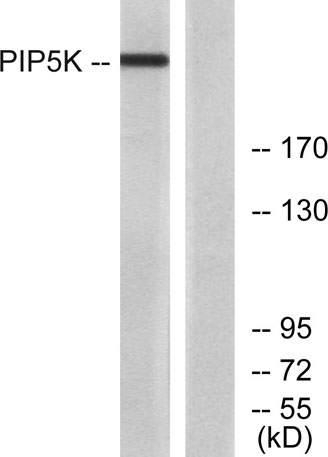
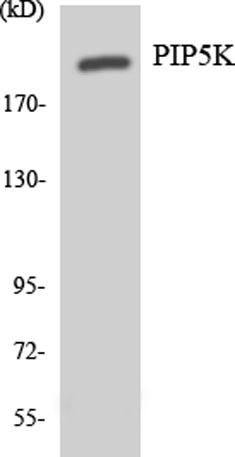
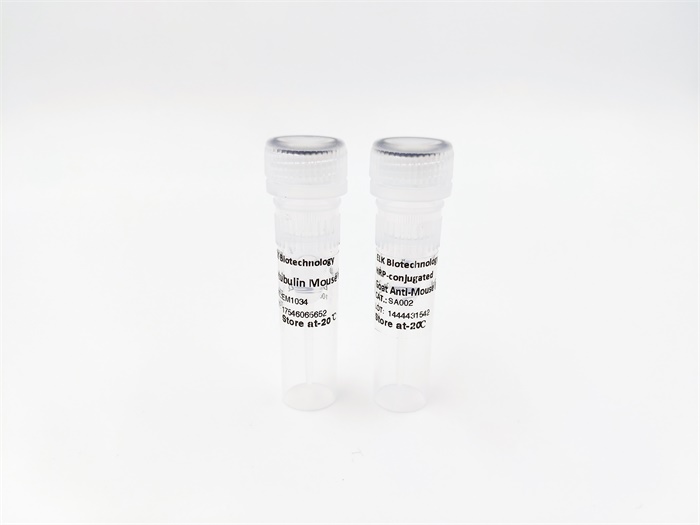
The antiserum was produced against synthesized peptide derived from human PIP5K. AA range:71-120
Storage:
-20°C/1 year
Clonality:
Polyclonal
Isotype:
IgG
Concentration:
1 mg/ml
Observed Band:
237kD
GeneID:
200576
Human Swiss-Prot No:
Q9Y2I7
Cellular localization:
Endosome membrane ; Peripheral membrane protein . Early endosome membrane ; Peripheral membrane protein. Cytoplasmic vesicle, phagosome membrane ; Peripheral membrane protein . Late endosome membrane ; Peripheral membrane protein . Mainly associated with membranes of the late endocytic pathway. .
Background:
Phosphorylated derivatives of phosphatidylinositol (PtdIns) regulate cytoskeletal functions, membrane trafficking, and receptor signaling by recruiting protein complexes to cell- and endosomal-membranes. Humans have multiple PtdIns proteins that differ by the degree and position of phosphorylation of the inositol ring. This gene encodes an enzyme (PIKfyve; also known as phosphatidylinositol-3-phosphate 5-kinase type III or PIPKIII) that phosphorylates the D-5 position in PtdIns and phosphatidylinositol-3-phosphate (PtdIns3P) to make PtdIns5P and PtdIns(3,5)biphosphate. The D-5 position also can be phosphorylated by type I PtdIns4P-5-kinases (PIP5Ks) that are encoded by distinct genes and preferentially phosphorylate D-4 phosphorylated PtdIns. In contrast, PIKfyve preferentially phosphorylates D-3 phosphorylated PtdIns. In addition to being a lipid kinase, PIKf