
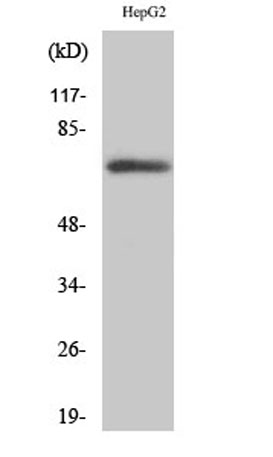
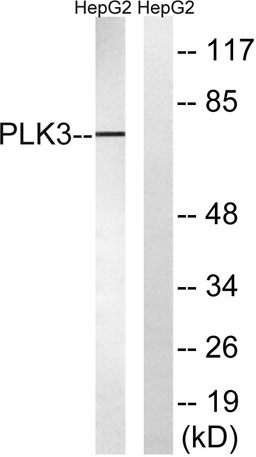
Western Blot: 1/500 - 1/2000. ELISA: 1/10000. Not yet tested in other applications.
Immunogen:
The antiserum was produced against synthesized peptide derived from human PLK3. AA range:231-280
Storage:
-20°C/1 year
Clonality:
Polyclonal
Isotype:
IgG
Concentration:
1 mg/ml
Observed Band:
70kD
GeneID:
1263
Human Swiss-Prot No:
Q9H4B4
Cellular localization:
Cytoplasm. Nucleus. Nucleus, nucleolus. Golgi apparatus. Cytoplasm, cytoskeleton, microtubule organizing center, centrosome. Translocates to the nucleus upon cisplatin treatment. Localizes to the Golgi apparatus during interphase. According to a report, PLK3 localizes only in the nucleolus and not in the centrosome, or in any other location in the cytoplasm (PubMed:17264206). The discrepancies in results may be explained by the PLK3 antibody specificity, by cell line-specific expression or post-translational modifications. .
Background:
The protein encoded by this gene is a member of the highly conserved polo-like kinase family of serine/threonine kinases. Members of this family are characterized by an amino-terminal kinase domain and a carboxy-terminal bipartite polo box domain that functions as a substrate-binding motif and a cellular localization signal. Polo-like kinases are important regulators of cell cycle progression. This gene has also been implicated in stress responses and double-strand break repair. In human cell lines, this protein is reported to associate with centrosomes in a microtubule-dependent manner, and during mitosis, the protein becomes localized to the mitotic apparatus. Expression of a kinase-defective mutant results in abnormal cell morphology caused by changes in microtubule dynamics and mitotic arrest followed by apoptosis. [provided by RefSeq, Sep 2015],